Showing posts with label SYFY. Show all posts
Showing posts with label SYFY. Show all posts
Tuesday, 21 April 2015

Wednesday, 18 March 2015
Competition Brief - SYFY - Submission and After Thoughts

I was only able to design one more storyboard in the end due to the sudden onslaught of numerous school projects and deadlines, while I had actually written 4 new scripts, I was only able to roughly sketch out 3 of them, and only finish one just a day before the deadline (As I was also struggling to finish another school assignment that was due on the same day). A part of me does not necessarily regret this however, as I was still able to finish one of my stronger ideas for submission, the others can be storyboarded as part of my portfolio when I have the time to do so.
I also took the time to make the storyboards a little more presentable by using a different template (Something less academic looking, as suggested by my classmates) as well as a different font, I also included the range concept board to see how they could actually be applied in various mediums, which should help the client visualise the idea better.
While I felt that I have actually submitted in a decent amount of content for this brief, I still hope that it is enough to get my idea across. Regardless, this has been a good experience, and I hope to get even better from here on out when it comes to brief analysing, hopefully I will slowly become more efficient when entering future competitions.
Wednesday, 21 January 2015
Responsive Session 6
I don't think I repeated myself as much as I did in this module... don't blame me if you find yourself reading the same thing throughout these Responsive posts.
Aside from the A3 boards (Was really happy that a lot more details could be seen this time round after I brightened the images), I ended up printing a few A4 sheets to support them, but I suppose there was no point really doing so since my peers didn't bother reading what I wrote, and not surprisingly asked questions that had already been answered.
Truth be told, I am actually starting to warm up to this practice of presenting my work to others and getting their feedback, while it was initially quite scary and stressful, we ended up laughing during these presentations, as we aren't given that much time to present each of our works properly (Which is a good and bad thing).
I can't say I have that many notes taken down for this last session, but I did get a lot of helpful feedback as always from my peers, which are all written down on the sheets that had been provided to us.
What I should mainly look into before I am finally finished with this brief is:
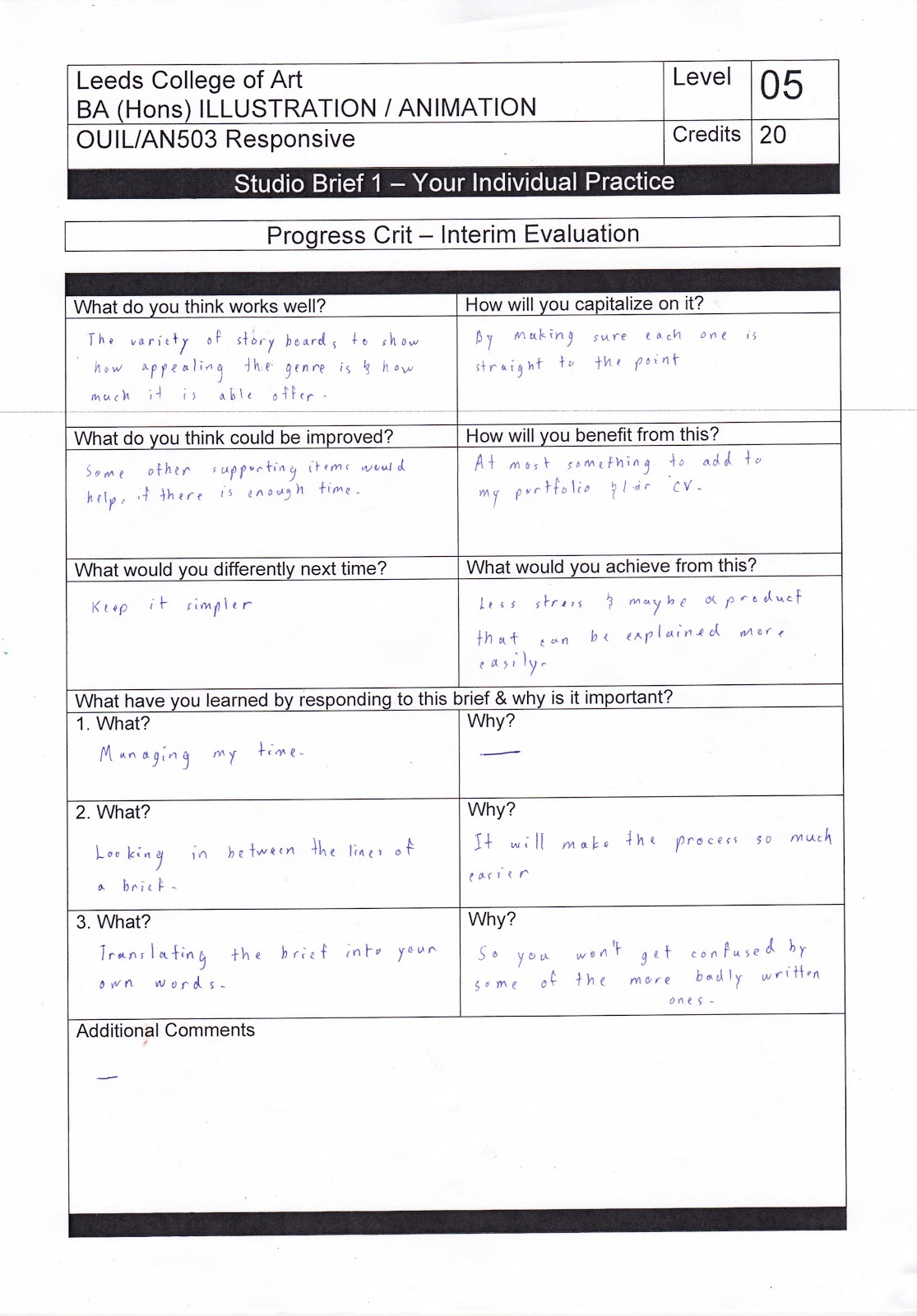
Also we were made to fill out this sheet at the end (I might replace these with a typed up version once the digital file is available on the eStudio):
Aside from the A3 boards (Was really happy that a lot more details could be seen this time round after I brightened the images), I ended up printing a few A4 sheets to support them, but I suppose there was no point really doing so since my peers didn't bother reading what I wrote, and not surprisingly asked questions that had already been answered.
About the Brief
SYFY - Get the Sci-fi audience to love
the Syfy brand for being the most passionate home for the genre
What's the problem?
The SYFY channel is not seen as relevant and their audience are critical of what they see as a lack of passion for the science-fiction genre. The SYFY channel also has increasing competition with the mass market channels who are now heavily invested in strong sci-fi and fantasy films/series launches.
What is it asking you to do?
To get sci-fi fans to love its brand.
What is it trying to achieve?
To show that the SYFY channel is the natural and passionate home for sci-fi despite how it probably doesn't have the best content as compared to other competitors.
Who is the audience?
18-25 year old sci-fi fans.
What are you expected to communicate to them?
Imagination, passion and great storytelling.
"We are the most passionate about sci-fi, not like those posers."
How will that message, idea or concept be delivered?
What I particularly like about this brief is how open the creative requirements are. And so as an animation student, I believe I could work on some storyboard concepts or even ideas for an entire promotional product.
The SYFY channel is not seen as relevant and their audience are critical of what they see as a lack of passion for the science-fiction genre. The SYFY channel also has increasing competition with the mass market channels who are now heavily invested in strong sci-fi and fantasy films/series launches.
What is it asking you to do?
To get sci-fi fans to love its brand.
What is it trying to achieve?
To show that the SYFY channel is the natural and passionate home for sci-fi despite how it probably doesn't have the best content as compared to other competitors.
Who is the audience?
18-25 year old sci-fi fans.
What are you expected to communicate to them?
Imagination, passion and great storytelling.
"We are the most passionate about sci-fi, not like those posers."
How will that message, idea or concept be delivered?
What I particularly like about this brief is how open the creative requirements are. And so as an animation student, I believe I could work on some storyboard concepts or even ideas for an entire promotional product.
Design Solution
Create a series of shorts based around
various areas of of the science fiction genre (Eg, soft and hard science
fiction, space opera, alternate history, dystopia, etc.) to show that SYFY deep
down knows what the genre is able to provide to its fans and that it is not
simply trying to cash in on the latest shows.
Why
have you chosen the colours/tone of voice you have?
Some types
of science fiction have more vibrant and alien colors, while others are a
little darker to fit the mood, it really depends.
Is
there going to be sound? If so, what kind?
Sound
effects will play an important role for each short, again it depends, the campy
short will use stock sound effects, while the “soft” sciece fiction short may
use more mechanical sound effects as well as some more realistic ones.
Why
have you chosen the brief? What are your motivations?
Out of all
the choices available, it is neither too easy nor difficult. It is also gives
me the opportunity to do a little storytelling in the form of advertising.
Will
it appeal to the target audience?
The point
is of each short is to pay some form of homage to a particular type of sci-fi
that most fans should immediately be familiar with, for example, the campy
short will pay homage to such classics as the original “Star Trek”, “Lost in
Space”, and “Land of the Lost”, while also making reference to classic cartoons
such as “Jonny Quest” and “Space Ghost”, and is purposely made to look like a
cheap animation with really limited movements.
Do
the characters talk in these shorts?
Each short is limited to
sound effects, music and very muffled voice recordings if necessary, there are
no real lines in any of the shorts consider the duration for each of them. Also
it saves money when it comes to voice actors.
Truth be told, I am actually starting to warm up to this practice of presenting my work to others and getting their feedback, while it was initially quite scary and stressful, we ended up laughing during these presentations, as we aren't given that much time to present each of our works properly (Which is a good and bad thing).
I can't say I have that many notes taken down for this last session, but I did get a lot of helpful feedback as always from my peers, which are all written down on the sheets that had been provided to us.
What I should mainly look into before I am finally finished with this brief is:
- To add in a few more storyboards (As 2 definitely wasn't enough to show the huge variety that the science fiction genre has).
- Make my presentation boards more appealing by playing around with better fonts and... remove the extra lines on the board (I am not entirely sure what they meant by this... I will have to ask them later on)
- Maybe make character concept boards for the other storyboards... or just exclude them entirely.
- Definitely create one concept that has more monster/alien designs.
- Perhaps combine the many types of animation to show the diversity? (It would be cheaper but I would have to completely overhaul the entire thing)
- Create a storyboard that is not pedominantly comic-book like to attract a different type of audience
Also we were made to fill out this sheet at the end (I might replace these with a typed up version once the digital file is available on the eStudio):
I must also rush to get the other briefs finished for this studio practice, hopefully I can get them finished during next week's tutorial week.
Monday, 15 December 2014
Responsive Session 5
This was the last session before our holiday, and I am surprised to say that I enjoyed it for once as compared to the previous sessions (And no, not because it was the last one before Christmas). It was great that our classes were no longer separated into different sessions, I had the chance to interact with the other Illustration students this time round and had a pretty productive session with the group I was assigned to (The only issue was the time limit given to us when we were made to present our boards to one another, and so I ended up trying to present mine within 1 minute after the announcement was made by our lecturers. since I ended up being the last one).
The storyboard was a homage to some of the earliest examples of sci-fi, that being the incredibly campy, and almost comic book-ish look. Inspiration was taken from such shows as "Lost in Space", Adam West's "Batman", "Land of the Giants" and even the original "Star Trek", and inspiration in terms of the art style was taken from shows such as "Space Ghost", "Johnny Quest", "Scooby Doo", and other animated shows from the 70s.
This short was meant to be done in a way where very limited animation would be used (Which could be easily done in After Effects), much like the old cartoons that used the Suncro-Vox technique back in the 50s.
I was more focused on the art style then, seeing as


 |
| Initially, they had goldfish bowls over their heads, but I decided not to include it in the storyboards as the extra outlines from the bowls might make each frame a little too busy. |
As an extra supporting item, a character concept board was created alongside the storyboards, I had wanted to created one for each different storyboard, being seeing as we were only allowed to print 3-5 boards, I decided to simply make one for the more developed idea (But I might whip up one for our next session).

The second idea was based around the soft science fiction genre (Examples including such shows as "Star Trek", "Stargate" and "The Outer Limits"), a darker colour palette is used for this one as compared to the first storyboard, with particular focus on cyan (A notable colour used in various examples I have seen), to give it that contrast it needs. While this one may seem a little more serious in tone as compared to the first one, I feel that vibrant colours could still be used, but only in selected areas.
For one of my last boards, as part of the range section, I applied some images to various medias to show where these animations can actually be viewed. Aside from television, other gadgets such as laptops, phones and tablets are included.

As usual, Fred got us to list a set of questions we wanted to ask ourselves:
What do we want to get out of feedback? (With Peer Group)
1. Does it meet the brief?
2. Strong enough concept?
3. Suitable for audience?
4. Can any improvements be made?
5. Is the visual direction right?
6. Is the medium suitable?
7. Is the choice/use of media appropriate?
What do we want to get out of feedback? (With Entire Class)
1. Appropriate concept?
2. Does the pitch meet the specifications of the brief?
3. Do the boards communicate the proposal effectively?
4. Is it suitable for the audience?
5. Is the media appropriate?
6. Is the response achievable in the time available?
7. Is the response appropriate to do the identified context?
8. Is the visual direction (Tone) right?
9. Do the deliverables meet the mandatory requirements?
10. Can the response be improved?
I was then provided helpful feedback by my group mates on what I should insert into the polished boards for the next session:
Areas of Improvement:
1. Describe the brief.
2. Maybe show contextual reference to show my idea process.
3. State why my work answers the brief.
4. Annotate my character designs.
5. Could the choice of art style be improved on to fit the target audience?
Questions that need answering:
1. Why have you chosen the colours/tone of voice you have?
2. Is there going to be sound? If so, what kind?
3. Why have you chosen the brief? What are your motivations?
4. Will it appeal to the target audience?
5. Do the characters talk in these shorts?
3. State why my work answers the brief.
4. Annotate my character designs.
5. Could the choice of art style be improved on to fit the target audience?
Questions that need answering:
1. Why have you chosen the colours/tone of voice you have?
2. Is there going to be sound? If so, what kind?
3. Why have you chosen the brief? What are your motivations?
4. Will it appeal to the target audience?
5. Do the characters talk in these shorts?
10 Expectations we expect to see one another in the next session (With Peer Group):
1. More polished and refined boards.
2. Specific direction.
3. More development of research and sketches.
4. More finalising.
5. More professional presentation.
6. More clarity.
7. More spelling and grammar checking.
8. Earlier preparation.
9. More justification of media and colours.
10. Actual production.
In the next session after Christmas, we are expected to return with a set of more polished boards (3-5 as usual), as well as a set of questions we wish to ask our peers after we present our boards to them.
10. Actual production.
10 Expectations we expect to see one another in the next session (With Entire Class):
1. More resolved visual concepts.
2. More appropriate visual aesthetic.
3. More professional/clearer presentation.
4. Clearer timescales and deadlines.
5. Refined brief (Rewrite it a little perhaps).
6. Production tests.
7. More content.
8. Mock ups.
9. Contextualisation.
10. Existing feedback and confirmed decisions.
10. Existing feedback and confirmed decisions.
In the next session after Christmas, we are expected to return with a set of more polished boards (3-5 as usual), as well as a set of questions we wish to ask our peers after we present our boards to them.
Thursday, 4 December 2014
Competition Brief - SYFY - Project Proposal 2
This form was also provided last week for us to fill in, it definitely gave me the chance to thinking a little deeper when it comes to such areas as my target audience (Speaking of that I will probably have to update that past blog post with a bit more information) as well as the tone of voice that is to be used for the deliverable. Thankfully it was also by this time that I had a much clearer on idea on what it was that I wanted to produce.

I will try to use this form and the other one for my other briefs later on if I can.
Responsive Session 4
Project proposals and Presentation Boards
The information provided below is simply to give you a better idea on how you can present your boards for next week, in the end it is up to you on how you wish to best present the design solution to your chosen brief.
Present concepts, research, and mock ups
. Clear, organised and professional manner
. Presenting information
If you learn the rules, you will know why they are necessary.
If you question the rules, you will know which ones are important.
And if you understand the rules, you can work out which ones to break.
Submission Guidelines:
. Do you need to create an Account or Profile before you can submit anything?
. Download any submission details/forms that you need to use alongside your main deliverable.
. Check Mandatories/Deliverables.
. Identify submission deadline.
. Clarify submission process and formats
. Prepare Submissions as directed
Submit Work on Brief and on Time.
What is expected and who is expecting it? Are they the expectations of the project, or actually yours? Double check on the bare minimum, don't kill yourself by accidentally doing too much, you have to be realistic if you want to get anything done.
Creative Compromise will be looked at throughout this module when it comes to all the briefs you take up on. There is a difference between wanting and needing to, and we have to remind ourselves that it is the latter we need (Haha) to do to be able to deliver those briefs on time.
What are you being asked to produce?
A physical product?
A workable proposal?
Or a visual concept (Most possibly this one in our case)?
Ever considered thinking that you don't have to make the entire thing?
Before you start working, figure out what exactly it is that you need to create. What is possible to develop, and whether it is enough to demonstrate what you want.
Don't do work you don't need to do.
While we have to consider our target audience in solving a design problem, in this case, it the judges that will be seeing it this time round. Do you have to demonstrate that you have done your research? Demonstrate the context and how it will look as a mock up?
Context, what you will find in most briefs, how do people interact with it? Super imposed mock ups that show people that it can exist in the real world.
3 Rules for Presentation Boards:
1. Start at the end (Impact), to show the audience or judges what it is you intended to produce. Don't present it like you would your other school assignments.
2. Product, Range, Distribution, how it will appear in different mediums
3. Audience, Function, Context
Think before you do (It will save you time and money), plan before you act, and question everything that our lecturers have ever said.
By next week:
Present 3-5 A3 Presentation Boards, as well as all the developmental work you have done so far up this point in the previous sessions.
And god help us all.
The information provided below is simply to give you a better idea on how you can present your boards for next week, in the end it is up to you on how you wish to best present the design solution to your chosen brief.
Present concepts, research, and mock ups
. Clear, organised and professional manner
. Presenting information
If you learn the rules, you will know why they are necessary.
If you question the rules, you will know which ones are important.
And if you understand the rules, you can work out which ones to break.
Submission Guidelines:
. Do you need to create an Account or Profile before you can submit anything?
. Download any submission details/forms that you need to use alongside your main deliverable.
. Check Mandatories/Deliverables.
. Identify submission deadline.
. Clarify submission process and formats
. Prepare Submissions as directed
Submit Work on Brief and on Time.
What is expected and who is expecting it? Are they the expectations of the project, or actually yours? Double check on the bare minimum, don't kill yourself by accidentally doing too much, you have to be realistic if you want to get anything done.
Creative Compromise will be looked at throughout this module when it comes to all the briefs you take up on. There is a difference between wanting and needing to, and we have to remind ourselves that it is the latter we need (Haha) to do to be able to deliver those briefs on time.
What are you being asked to produce?
A physical product?
A workable proposal?
Or a visual concept (Most possibly this one in our case)?
Ever considered thinking that you don't have to make the entire thing?
Before you start working, figure out what exactly it is that you need to create. What is possible to develop, and whether it is enough to demonstrate what you want.
Don't do work you don't need to do.
While we have to consider our target audience in solving a design problem, in this case, it the judges that will be seeing it this time round. Do you have to demonstrate that you have done your research? Demonstrate the context and how it will look as a mock up?
Context, what you will find in most briefs, how do people interact with it? Super imposed mock ups that show people that it can exist in the real world.
3 Rules for Presentation Boards:
1. Start at the end (Impact), to show the audience or judges what it is you intended to produce. Don't present it like you would your other school assignments.
2. Product, Range, Distribution, how it will appear in different mediums
3. Audience, Function, Context
Think before you do (It will save you time and money), plan before you act, and question everything that our lecturers have ever said.
By next week:
Present 3-5 A3 Presentation Boards, as well as all the developmental work you have done so far up this point in the previous sessions.
Wednesday, 26 November 2014
Competition Brief - SYFY - Moodboards

I was still feeling rather drained and unexpired, and so I ended up drafting another mindmap in hopes of getting some ideas going in my head.
Inspiration

With some design solutions in mind, I then quickly put together a mood board to figure out some colour palettes that best represents the genre as well as some appealing art styles and designs. While most colour palettes are rather moody in tone, there is at least one dominant colour that is vibrant enough to create a beautiful contrast from all of the browns and greys, such as blue or orange. Classic sci-fi works however are considerably more vibrant when it comes to the colours that they use for their promotional items (This was probably because these shows later on were still shown in black and white, and so they had to take advantage of colour usage when promoting it).
Target Audience

I believe that sci-fi fans vary greatly from one another, and that the only thing that truly brings them together is the love for (And unfortunately their passion for it also leads to deep conflicts with one another as we have seen over the years). And so I honestly found it quite challenging to pinpoint one particular target audience when we were told to think outside of the brief. That saying, the brief simply states that its target audience are sci-fi fans aged from 18-25, I suppose I could use that as my starting point and for the time being focus on those age groups, and consider older and younger age groups later on.
I am particularly keen on researching into the cosplayers and roleplayers however, seeing how creatively they show their love for the genre by going all out with their cosplays, and of course, having fun whilst doing so.
A bit more research into the target audience will be done later on.
Competition Brief - SYFY - Project Proposal
We are required to fill out this sheet (Which in a way also works as rough proposal) for every brief we decide to take up for this first part of the module, to show how well we have understood the issues that need to be addressed and how we plan to solve them. And so I will make sure to answer to reuse this sheet for the other briefs that I had also started on or already finished.

Tuesday, 25 November 2014
Competition Brief - SYFY - Types of Sci-Fi
Science fiction is a wide-ranging genre, with a lot of blurred edges and overlaps between groupings. But a number of types can be broadly identified:
"Hard" science fiction |
| "I, Robot" |
Extrapolates directly from today's modern science and emphasises scientific detail and accuracy. Hard science fiction writers are often scientists themselves (Isaac Asimov, Gregory Benford). Other movie examples include "2001, A Space Odyssey", "2010: The Year We Make Contact", "12 Monkeys" and "A.I. Artificial Intelligence".
"Soft" science fiction,
"Soft" science fiction,
 |
| "Star Trek" |
This genre is based on and explores the "soft" sciences, and especially the social sciences (Anthropology, political science, and so on) rather than engineering or the "hard" sciences (For example, physics, astronomy, or chemistry), or is not scientifically accurate, or both of the latter. Soft science fiction of either type is often more concerned with character and speculative societies, rather than scientific or engineering speculations.
In contrast, emphasises social issues and issues of personal identity. Examples could include Star Trek in television; among novelists, Ursula K. Le Guin. Other examples include "The X-Files", "Planet of the Apes", "Terminator" and "The Outer Limits".
Today, the term is often used to refer to science fiction stories which lack a scientific focus or rigorous adherence to known science.
Space opera
 |
| "Star Wars" |
A subgenre that often emphasises romantic, often melodramatic adventure, set mainly or entirely in outer space ("The Fifth Element" also comes to mind, only in certain parts of the film that is), usually involving conflict between opponents possessing advanced abilities, weapons and other forms of advanced technology, the name is pretty much a play on the term "soap opera".
Involves epic scale and a conflict between idealised heroes (often involving a wizened mentor and an untried youth) pitted against unredeemable villains. In film, the original Star Wars is a classic example; a well-known novelist in this type is E.E. "Doc" Smith. Other examples include "Titan A.E.", "The Last Starfighter" and "Farscape. Some animated examples include "Cowboy Bebop", "Mobile Suit Gundam" and "Space Pirate Captain Harlock".
This sub genre has also been parodied quite a bit in shows such as "Spaceballs", "Futurama", "Bill, the Galactic Hero" and "Star Smashers of the Galaxy Rangers".
Alternate History
 |
| "District 9" |
This is a branch of science fiction that extrapolates from a point in the past, rather than from today, and takes a different path from the one we took. Questions involve what the world might be like if the Axis powers had won World War II, or if Lincoln had not been shot. Master practitioners include Philip K. Dick and Harry Turtledove. Other examples include "Watchmen", "Source Code" and "Back to the Future 2".
Dystopia
 |
| "The Matrix" |
This subgenre starts by rejecting the idea that "scientific advance" with automatically bring about a superior civilisation; the dreamed-up reality might in fact be as corrupt and unjust as the darker days of our own world. After World War II dystopian fiction often assumed a nuclear apocalypse, with survivors fighting to retain their humanity (Mad Max, A Boy and His Dog); but such a cataclysm is not necessary (Blade Runner).
Sunday, 23 November 2014
Competition Brief - SYFY - Mindmapping
 |
| Overview |
 |
| Brainstorming |
Competition Brief - SYFY - Overview
Well, this is actually a competition brief, but I was still hoping to do it as part of the 5 briefs alongside the main one I had chosen:
Who
SYFY UK
What
The SYFY channel is no longer seen as relevant, their audience believing that they lack passion in the genre they are clearly meant to represent, especially with the increasing competition that they have to face in recent years.
How
Being an open brief, we have to find ways to get sci-fans to love this channel (Or at least gain some interest in it), suggested ideas are campaigns, events, promotional products or digital products.
When
Deadline is on the 19th March 2015.
Why
Out of the three I had previously chosen, this seems like a brief that is neither too hard or easy to work on, I am somewhat familiar with the SYFY brand as compared to the Whistles brand, and so there won't be as much stress when it comes to researching on it. and seeing that it is an open brief, there are really a lot of opportunities and trying out various ideas. In the end, it really is the best brief that gives me the chance to push myself just a little (Despite how reluctant I am to do so).
Who
SYFY UK
What
The SYFY channel is no longer seen as relevant, their audience believing that they lack passion in the genre they are clearly meant to represent, especially with the increasing competition that they have to face in recent years.
How
Being an open brief, we have to find ways to get sci-fans to love this channel (Or at least gain some interest in it), suggested ideas are campaigns, events, promotional products or digital products.
When
Deadline is on the 19th March 2015.
Why
Responsive Session 2
Why have you chosen the brief?
This brief applies the most to my interests and is open enough to allow me to brainstorm on a variety of ideas and techniques. While I do hold a large amount of interest in the sci-fi genre, I had truly took the chance to take a deeper look into it, and so this brief will give me the chance to research more into it and to better understand it's context and the other aspects that surround it.
What do I want to get out of it?
Something outstanding enough to put into my portfolio and resume, some more experience in terms of professionalism and efficiency when it comes to responding to similar competition or work briefs in the future.
What do you need to produce in response to the brief?
Being an open brief, suggested ideas are a connected idea/campaign (Eg, working across TV, Digital, Social, Posters, Press, Retail and other relevant channels), an event, a promotional product or a digital product.
At this stage, what do you want to produce in response to the brief?
Most definitely something of relation to Animation, while I remain unsure that I can create a fully done animation piece, I am sure that I can create adequate enough concept pieces such as storyboards, character and prop designs, and other conceptual narrative works, etc.
Note: Apply this to future briefs before making the decision of carrying them out, especially for the other briefs we decide to respond to in this module.
In the brief identify:
5 Most Important Words
1. Passionate
2. Imagine
3. Open
4. Storytelling
5. Engaging
5 Most Important Considerations?
1. Be impactful
2. Be engaging
3. Be playful
4. Ultimate fans of sci-fi
5. Imagine Greater
5 Related Products
1. Mascot Toys
2. Commercial - Live and/or Animated
3. Event - Convention Panel/Booth
4. Stings
5. Campaign
5 Related Places
1. ComicCon
2. Star Trek Convention
3. Transport (Buses and Trains)
4. Home
5. Sci-Fi School Club
The Positives and Negatives of sharing the same ideas with others:
Positives
1. On the right track
2. Opportunity to generate ideas from there
3. Group together key points, identifying the most crucial aspects
4. Share a level of understanding with one another, allowing a smoother transition in terms of work
5. Reassuring (Similar to 1) and confidence that can come from it
6. Clarity on the brief
Negatives
1. Limited ideas
2. More competition
3. False reassurance on the right track, before someone comes into question it
4. Too easy, boring, going for overly obvious answers
5. How will it stand out then?
6. No level of criticality or the opportunity to improve it, losing the chance to stand out
The positives and negatives of having different ideas from one another could be a reverse from the positive and negative points of having the same ideas as one another.
Who is the audience?
18-25 year old sci-fi fans.
Who should the audience be?
Sci-fi fans of both genders, teenagers and adults, original sci-fi fans.
Who could the audience be? Why?
I still believe that it will be the same answer as the previous one, it will however be challenging to accommodate to two genders. Not that we are trying to differentiate them incredibly from one another (Not like Nintendo Gamer Girls...), but we also need to consider some of the differences between the male fans and the female fans and their thought process on why they are fans of the genre in the first place.
What do they do?
There are a variety of people who are considered sci-fi fans, they don't have to work in an area connected to their interests, but could simply be a fan of it.
Where do they go?
What do they buy?
What do they want to be?
What are their aspirations, dreams, motivations?
In the next session, we need to complete a project proposal as specifically as possible. And bring contextual references for our initial idea, such as concepts, thumbnails, etc.
This brief applies the most to my interests and is open enough to allow me to brainstorm on a variety of ideas and techniques. While I do hold a large amount of interest in the sci-fi genre, I had truly took the chance to take a deeper look into it, and so this brief will give me the chance to research more into it and to better understand it's context and the other aspects that surround it.
What do I want to get out of it?
Something outstanding enough to put into my portfolio and resume, some more experience in terms of professionalism and efficiency when it comes to responding to similar competition or work briefs in the future.
What do you need to produce in response to the brief?
Being an open brief, suggested ideas are a connected idea/campaign (Eg, working across TV, Digital, Social, Posters, Press, Retail and other relevant channels), an event, a promotional product or a digital product.
At this stage, what do you want to produce in response to the brief?
Most definitely something of relation to Animation, while I remain unsure that I can create a fully done animation piece, I am sure that I can create adequate enough concept pieces such as storyboards, character and prop designs, and other conceptual narrative works, etc.
Note: Apply this to future briefs before making the decision of carrying them out, especially for the other briefs we decide to respond to in this module.
In the brief identify:
5 Most Important Words
1. Passionate
2. Imagine
3. Open
4. Storytelling
5. Engaging
5 Most Important Considerations?
1. Be impactful
2. Be engaging
3. Be playful
4. Ultimate fans of sci-fi
5. Imagine Greater
5 Related Products
1. Mascot Toys
2. Commercial - Live and/or Animated
3. Event - Convention Panel/Booth
4. Stings
5. Campaign
5 Related Places
1. ComicCon
2. Star Trek Convention
3. Transport (Buses and Trains)
4. Home
5. Sci-Fi School Club
The Positives and Negatives of sharing the same ideas with others:
Positives
1. On the right track
2. Opportunity to generate ideas from there
3. Group together key points, identifying the most crucial aspects
4. Share a level of understanding with one another, allowing a smoother transition in terms of work
5. Reassuring (Similar to 1) and confidence that can come from it
6. Clarity on the brief
Negatives
1. Limited ideas
2. More competition
3. False reassurance on the right track, before someone comes into question it
4. Too easy, boring, going for overly obvious answers
5. How will it stand out then?
6. No level of criticality or the opportunity to improve it, losing the chance to stand out
The positives and negatives of having different ideas from one another could be a reverse from the positive and negative points of having the same ideas as one another.
Who is the audience?
18-25 year old sci-fi fans.
Who should the audience be?
Sci-fi fans of both genders, teenagers and adults, original sci-fi fans.
Who could the audience be? Why?
I still believe that it will be the same answer as the previous one, it will however be challenging to accommodate to two genders. Not that we are trying to differentiate them incredibly from one another (Not like Nintendo Gamer Girls...), but we also need to consider some of the differences between the male fans and the female fans and their thought process on why they are fans of the genre in the first place.
What do they do?
There are a variety of people who are considered sci-fi fans, they don't have to work in an area connected to their interests, but could simply be a fan of it.
Where do they go?
- Conventions
- LARPs
- Comic Book Shops
- Film Studios
- TV Shops
- Places of Transport (Eg, Buses and Trains)
What do they buy?
- Merchandise
- Props
- Fanart/Zines
- DVDs
- Books
What do they want to be?
What are their aspirations, dreams, motivations?
In the next session, we need to complete a project proposal as specifically as possible. And bring contextual references for our initial idea, such as concepts, thumbnails, etc.
Subscribe to:
Posts (Atom)